Contextual Document Assistant
RAG pipeline over PDFs and text: chunking, Universal Sentence Encoder embeddings, Elasticsearch, and LLaMA 3.3 for query rewriting and answers.
Academic project for the AI Technologies Workshop course.
- Year
- 2025
- Team
- Ismael Meijide · Giuliano Bardecio · Joaquín Abeiro

Project Report: RAG System Implementation
1. Introduction
To implement the Retrieval-Augmented Generation (RAG) system, the following technical stack was defined:
- Environment: Python (Google Colab).
- Embeddings: Universal Sentence Encoder (USE).
- Vector Database: Elasticsearch.
- Chunking Strategy: Token-based segmentation.
- LLM: LLaMA-3.3-70B-Instruct-Turbo (for query expansion and response generation).
2. Development Process
2.1 Document Chunking
Large documents exceed model token limits and require splitting for precise semantic search.
- Token-based Chunking: Uses a maximum token count and an overlap parameter for context redundancy.
- Current Implementation: Uses sentence parsing combined with maximum word thresholds to maintain semantic consistency.
2.2 Embedding Generation
We evaluated multiple models, including all-MiniLM-L6-v2, Word2Vec, and Mistral-7B-v0.1.
- Selection: Universal Sentence Encoder (USE) was chosen for its superior balance of semantic accuracy and computational efficiency.
- Storage: Each chunk is stored as a
{chunk, embedding}tuple.
2.3 Vector Storage & Indexing
- Engine: Elasticsearch was selected for its reliability and efficient KNN (K-Nearest Neighbors) support.
- Optimization: We tuned the "m" parameter for node connections and tested multiple similarity metrics (Cosine, Dot Product, Euclidean).
- Indexing: Chunks are indexed with original text and Document IDs. We utilized
tqdmfor real-time progress tracking during the indexing phase.
2.4 Semantic Search & Query Expansion
To improve retrieval accuracy, the system follows these steps:
- Query Rewriting: The LLM refines the raw user input into a scientifically aligned query.
- Embedding: The refined query is transformed into a vector via USE.
- Search: Elasticsearch executes a KNN search to retrieve the top 5 most relevant chunks ($k=5$, $num_candidates=10$).
2.5 Final Response Generation
The system utilizes LLaMA 3.3 70B to:
- Process the retrieved context and the rewritten query.
- Construct a context-rich prompt.
- Generate an evidence-based, professional answer.
2.6 User Interface (Gradio)
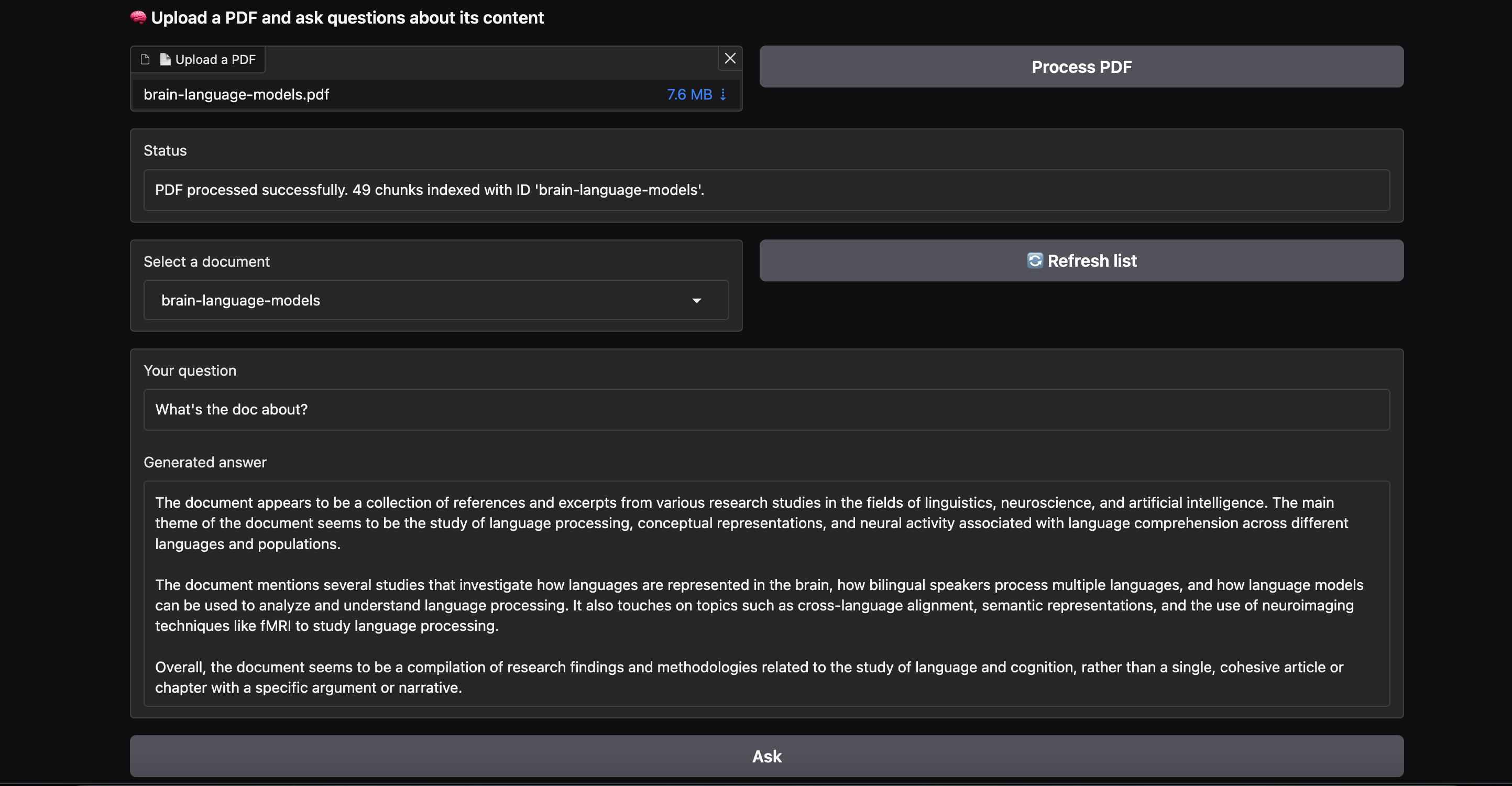
A web UI was built using Gradio, supporting:
- PDF Uploads: Text extraction via
PyMuPDFand processing viaspaCy. - Real-time Feedback: Progress bars for indexing and interactive Q&A.
- Error Handling: Graceful management of subprocess errors and package dependencies.
3. Challenges & Strategies
Challenges Encountered
- Resource Constraints: Balancing model performance with Google Colab's hardware limits; solved by using remote inference for LLaMA 3.3.
- Data Cleaning: Addressing formatting issues in PDFs to ensure reliable chunking.
- Model Evaluation: Comparing MiniLM vs. USE for specific integration needs.
Implemented Strategies
- Query Improvement: Using LLM-driven rewriting to minimize ambiguity.
- Hallucination Mitigation: If the retrieved context is insufficient, the model is instructed to state that the information is unavailable.
- Consistency: Using the identical embedding model for both indexing and live queries.
4. Results and Testing
Embedding & Chunking Tests
While all-MiniLM-L6-v2 showed a slightly higher average similarity ($0.4407$ vs. $0.4232$), USE was selected due to its seamless integration with TensorFlow Hub and superior batch processing reliability.
LLM Performance
Testing confirmed that the system:
- Generates coherent and professional summaries.
- Correctly identifies "out-of-context" questions (e.g., asking about New York tourism when the database contains scientific papers).
5. Live Demo
The system is deployed and accessible at the following link: RAG System Demo on Hugging Face